Between olive trees and institutions: reflections from community work in Morocco
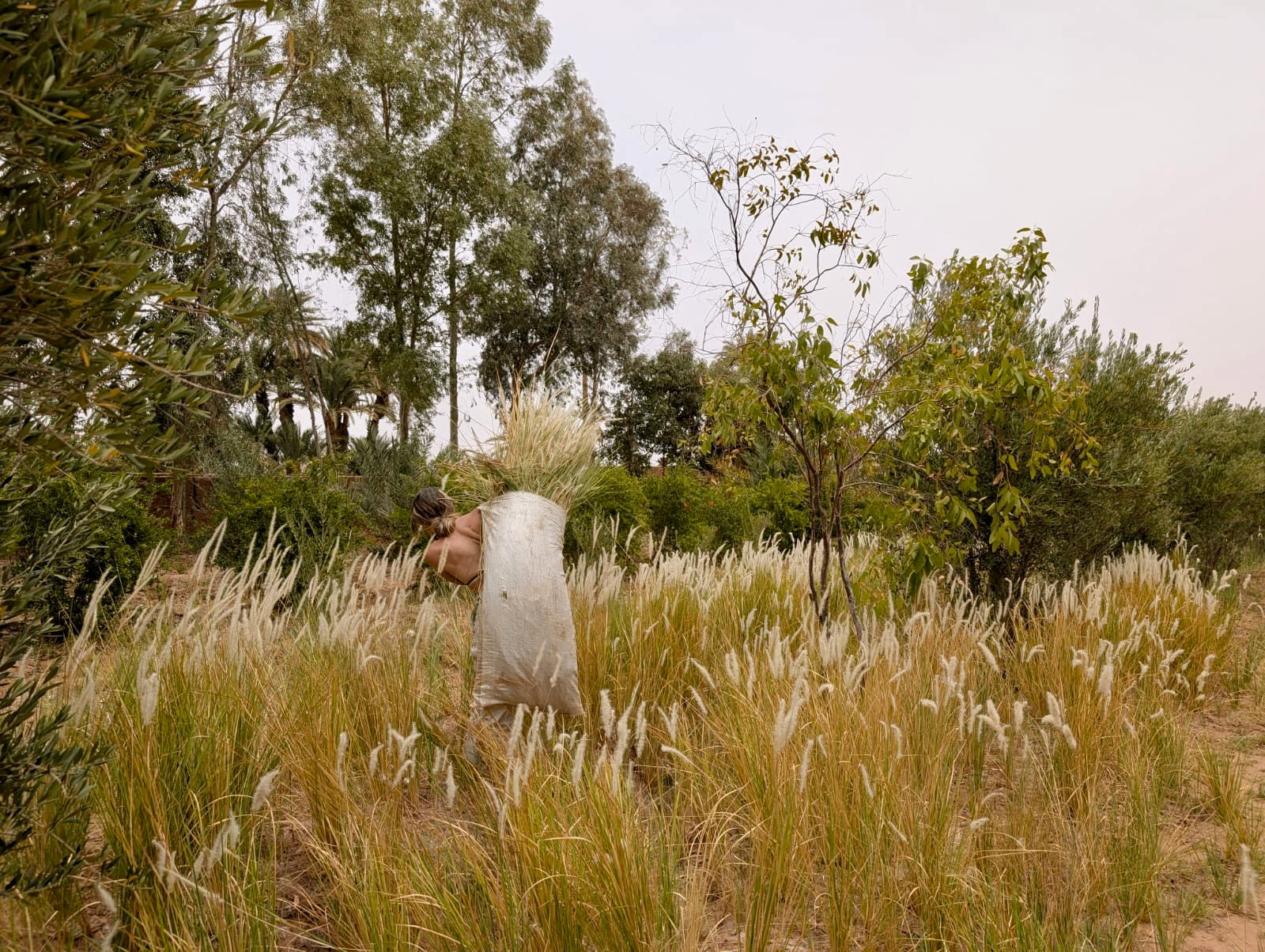
I've always thought that traveling is not just for discovering new places, but for opening our eyes to entirely new worlds. It's now, between olive and pomegranate trees, with the lilting song of the muezzin echoing in the background and carrying across the dunes, that I've finally found the space to reflect on my path in a way I never truly allowed myself to before. Somewhere between the medinas, the tiled courtyards, the cats sleeping in the shade and the conversations over mint tea at the language school, I've been reflecting on my dreams, my achievements, my childhood, and all that preceded my studies, my jobs and years abroad, when I slowly started measuring myself against the standards of people who had grown up in entirely different worlds from mine.
I think for a very long time I was so focused on becoming someone important, on meaning something to the world, on accessing spaces that I associated with impact and legitimacy, that I forgot that I had always meant the world to my own community already. After all, unintentionally, I had always built communities around myself everywhere I went! Perhaps because for most of my life excellence felt less like a choice and more like a necessity, I assumed that meaningful change would stem exclusively from institutions, policymaking, elite universities and careers which sounded important enough to justify all the sacrifices that had preceded them.
I spent my childhood happy and quite far from prestige, in a seventy-square-meter flat with the kitchenette in the living room. I shared a bedroom with my brother until the age of 18, skipped some school trips and summer camps, and mum timed laundry around the hours when electricity cost less. My dad used to study for his university degree at the same table where me and my brother did our homework, and I believe somewhere along the line I internalized the idea that education and upward mobility were not merely aspirations but responsibilities.
Over the years, ambition and curiosity carried me through scholarships, two degrees, top grades and eventually into the world of advocacy and humanitarianism, fields I genuinely believe can improve people's lives. I specialized in migration and development studies because I care deeply about people whose voices are often overlooked – especially at a time in which migrants and refugees become targets of hostile and unjustifiable political narratives which they are rarely in control of. If I could somehow gain access to the “right” institutions, then surely I'd be able to change things from within, one day?
I always imagined policymaking spaces as places filled with people desperately trying to improve the world, and part of me still believes this to be true. However, studying and working within those environments also made me realise how elitist many of them remain, and how disproportionately accessible they are to people who have always known how to navigate them simply because they were born close to them. What struck me most was not necessarily malice, but distance from the realities most people experience daily: financial precarity, overcrowded homes, the exhaustion of parents constantly working, the feeling of constantly trying to catch up with someone who started the race miles ahead. I spent many years idealizing institutions and accepting the notion that real change stems primarily from laws, policies, regulations and large-scale programs.
Yet here in Morocco, some of the most rewarding forms of contribution I've experienced have been remarkably small and ordinary: looking after Marie's pets and garden while she travelled away from M'Hamid El Ghizlane; teaching Italian to students in Kalaat Sraghna who dream of building lives abroad; meeting people who are working on projects creatively and outside formal structures. I want to be careful about what I'm claiming, because watering a garden does not change the world and I'd be flattering myself to call it impact. But it bought me something institutions rarely manage to afford: closeness. You learn what a place really needs by being inside its daily life – by feeding someone's cats, sitting through a lesson, listening to the stories of those around you. The small acts weren't the contribution; they were rather how I got close enough to see clearly, and to realise that some of the most meaningful forms of social contribution happen informally, collectively and locally, often without funding, recognition or institutional validation.
I want to be honest about my place in this: I am a visitor, not a member of these communities. The people who truly see what Kalaat Sraghna or M'Hamid El Ghizlane may need are the people who experience the reality of these places every day. My role (the most any outsider can honestly claim) is limited to observing norms, customs and any solutions implemented locally, understanding the rationale behind them and never designing new ones over their heads. If proximity is what good change depends on, then the first discipline is knowing whose proximity counts, and in Morocco, that cannot be mine.
One of the people I met in Kalaat Sraghna, Samiha, is currently pursuing a doctorate in biology while also developing and commercializing her own supplements through a company she founded herself called S'hihty. Her small business, which she has built from scratch alongside all the formulas behind her products, made me think about how many talented people come up with remarkable ideas and ventures and apply their expertise beyond traditional pathways, often with little recognition. Although Samiha is an entrepreneur and she would certainly like her business to succeed, she does not speak about wealth in the way entrepreneurs usually do. She speaks about freedom, independence and possibility. Coming from a large family and currently living in Kalaat, she dreams of moving to the United States and building a livelihood for herself on her own terms. Her story reminded me that entrepreneurship is not necessarily about profit maximisation, but rather about agency – the ability to carve out opportunities where few seem to exist.
A similar thought kept returning to me when thinking about friends of mine back in Italy with degrees in international relations, chemistry, law, literature and so on. After months or years of searching for stable employment, many decided to create their own paths: one became a tour guide and loves her work, another works in a local NGO dealing with international adoptions in Sierra Leone, another launched a web design business, another became an actor, another founded one of Italy's largest cinema blogs. They have been brave enough to step outside their comfort zones and, by taking a leap of faith, they found new paths to happiness and to success.
We are living in a historical moment in which the promise of stability attached to traditional careers is increasingly collapsing, yet many of us continue chasing that ideal because we have internalized the idea that impact occurs through globally recognized structures. While I too am guilty of this, I recently decided to leave my corporate job in London and dedicate myself to purpose-driven work without having an exact outcome in mind. In many ways, my time in Morocco was an extension of that decision: an opportunity to explore different ways of creating value in the world. I witnessed creativity, resilience, mutual support, and principles which I had often encountered in my international development studies (too often overlooked in practice): a course of action designed from the top down, however well-intentioned, rarely achieves lasting impact; large-scale, one-size-fits-all frameworks rarely account for the complexity of local contexts and cultural specificities.
The more time I spent reflecting on this, the more I realized that the same principle might apply beyond humanitarian work. We tend to approach our own lives through similarly standardised models of success, assuming that there is one legitimate path to fulfilment, such as an institutional or a corporate career. Yet just as communities thrive when they are empowered to shape local solutions, individuals thrive when given the freedom to build lives in accordance with their own aspirations, passions and circumstances. Perhaps the one-size-fits-all model is becoming obsolete not only in development, but also in the way we think about work, purpose and success itself. We might very well be best placed to decide what a meaningful life looks like for ourselves, so long as in such life we are able to achieve material security and fulfilment. Perhaps we underestimate our capacity to create livelihoods on our own terms, with the help of community initiatives, freelance work, or other forms of value creation?
Of course policy matters, institutions matter, laws matter, and I still believe deeply in the importance of advocacy and systemic change. I would love to play a role in shaping positive change. At the same time, I have come to appreciate the transformative potential of personal projects and locally grounded initiatives. We have far more power than we realise, especially when we decide to build something together rather than endlessly waiting for permission to contribute. Therefore, I've stopped framing this dilemma as institutions versus individuals. Institutions carry what individuals cannot: scale, resources, the durability to outlast any one person's energy. But scale built on distance tends to fail, and unfortunately many institutions are structurally too far from the people they ought to serve. In sum, institutions without proximity build the wrong thing efficiently, but proximity without institutions stays small and unfunded. The work, then, is to connect them – and we don't need anyone's permission to start from the proximity side.
To end this reflection on a personal note, I think I've truly learned the above on my recent travels. I was less concerned with finding answers than with intentionally questioning some of the assumptions I had carried with me for years. That's why, for the first time, I took a break and stepped back from the lessons I absorbed growing up, from the ambitions that carried me through my academic and professional life, and from arbitrary definitions of success. The most valuable lesson I'll take away from this is there are many ways of creating value in the world and perhaps more of them deserve our attention. If we want to bring about positive change, we can begin right where we are and with the people already around us. That's not a lesser path to impact; it is often where real impact begins.
Join the conversation
Loading comments…